Musings: Still evolving thoughts & comments
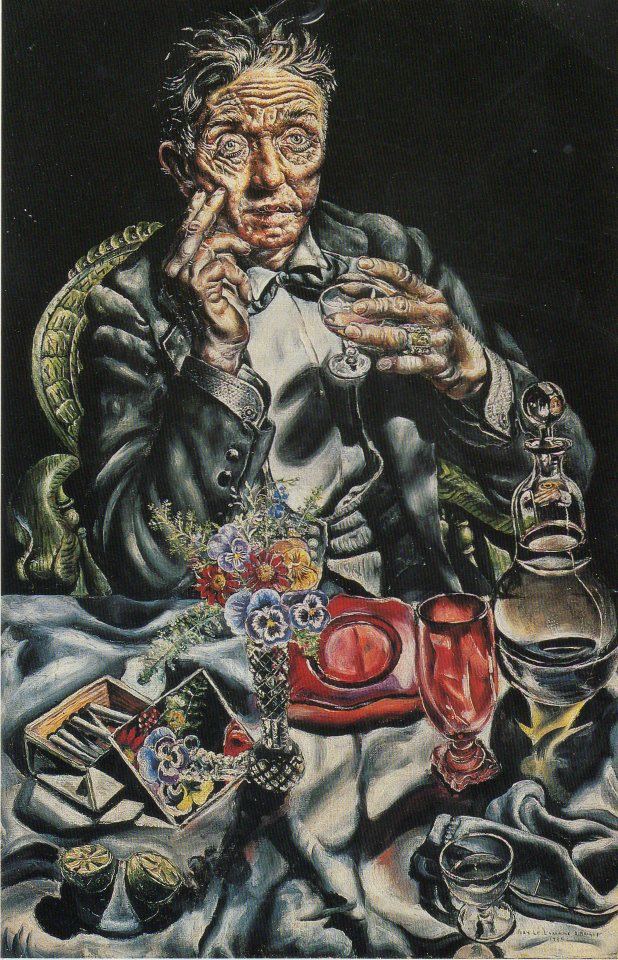
| Self-Portrait 1935 by Ivan Albright (1897 - 1983) 77 x 50.6 cm / Copyright Art Institute of Chicago
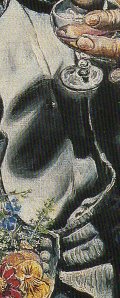
Ivan Albright was clearly some sort of artist. Does this look like the mirror-image of a 38-year-old to you? Even a very dissipated 38-year-old? I don’t think so, myself. There are many, many things one could say about the artist and the artwork. He was famous, you’ll find, for his ability to make images of stuff – people and objects - in obvious states of decay. He made images of decay that are fascinating and hideous, too. But there is something else of interest here. You might call it... skullduggery. What brand of shirt is the man depicted here wearing? OK, I don’t know either. But take a close look at that shirt. Notice anything? Look at this detail shot. Ignore the glass and the fingers above. Ignore the flowers below. Squint. Perhaps this "hidden" image will be more visible to those familiar with the Mexican "Day of the Dead" festival. It's a skull. At least, that's what I see. Do you see a skull? Am I seeing things? Or is everyone else missing something? I don't know. A quick Google search doesn't turn up any indication that anyone else has noticed. It’s my guess that, in fact, very few have noticed. This concerns me. If we can't see what's right in front of us, how likely are we to notice things that aren't? The importance of paying attention has rarely been more obvious to anyone who follows economics and politics in the USA, at least. That’s why it’s so important to be aware of our own blind spots, so to speak. Assuming, of course, that I’m not a nut job. And I might be. After all, I see a skull in a shirt, in a painting, that’s a self-portrait of a very prematurely old young man. For better or worse, I've been encountering more of these insights - or fantasies - of late. I've documented some of them in an essay, THE RIDDLE OF THE SPHINX, FOWL PLAY AND OTHER ENIGMAS IN THE GRAPHIC ART OF LEONARD BASKIN located elsewhere on this site. And, for your further edification, another image by Ivan Albright: The Picture of Dorian Grey, used in the movie of the same name. Look closely! |
Thomas Mann on Beauty In German: ,,Aber wieviel besser ist es doch, habe ich mir oft gesagt, der Welt Vertrauen einzufloessen, als ihre Leidenschaften zu erregen! Wieviel besser, ihr >gut< als ihr >schoen< zu erscheinen." In English: It is certainly much better, I have often said to myself, to increase the stability of the world, that to excite its passions. Much better, to be considered >good< than to be considered >beautiful<. Thomas Mann, Dr. Faustus |
| How to Become an Artist "I'm so happy that you have given up all hope of becoming an Artist, and that from now on you are going to paint and draw, and sculpt, for your own pleasure. "Hallelujah! "Now you are an Artist in the true sense. "Academia is fine and a helpful resource, but the making of Art is essentially making love to life." Artist William Girard in a letter to Glenn S. Michaels 1982 |
Vincent Van Goth. Excerpt from a letter to his sister.
"And if with good intentions we search the books which it is said shed light in the darkness--though inspired by the best will in the world, we find extremely little that is certain, and not always the satisfaction of being comforted personally. And the diseases which we civilized people labor under most are melancholy and pessimism.
|
Don't Touch the Paintings. Let Them Touch You, Instead.
When I was an undergraduate Art History student… 0ne of my classmate’s favorite activities during those trips (to the Cleveland Museum of Art) was to…run her hand across the surface of a painting. A chill would run up my spine every time …because touching the art was a major art world taboo. It still is, of course… This really is a shame. One reason is that running one’s hand across the surface of a painting, if done gently, causes virtually no damage(conservators will vehemently protest otherwise, of course), but more importantly, texture is one of a picture’s most basic and important elements." Inspirational Journey Exhibition at the Plantera Group; By Jay B. Miller -----------------------------------------
After reading the introductory comment, quoted above, I thought about the mural on McDowell near 3rd Ave that I had so enjoyed until someone defaced it a few months ago. I think it graphically demonstrates what the public can be trusted to do with or to art when a common sense standard of respect is arbitrarily abandoned. Then, I wrote the following...
Uninvited touching in the workplace is generally called either assault or sexual harassment and is often grounds for immediate dismissal.
Indiscriminate handling of paintings in a museum is equally inappropriate! Don't do it... unless the artist has explicitly invited the public to do so.
I once saw a woman run her hands over a small Botticelli painting. The guard had stepped away.
The Botticelli was only 500 years old. Beautiful? Oh, yeah. It was a touching depiction of a Madonna and child. And that's my point. We go to museums in order to be "touched" by art. Not to return the favor.
Light itself, as any resident of the American West will attest, can wreak severe damage on skin or any other surface it touches, given a bit of time. In other words, it ain't smart to hang a fine painting in a place where it is exposed to direct sunlight for extended periods of time... at least, not if you live in Phoenix.
I put it to you, what is lighter than light? Not much. Certainly not human hands. So if light can damage a painting, why should it be so hard to understand that the loving caresses of umpty-ump oily, damp, gooey, dirty hands might damage a painting irreparably? Of course, not every caress will be gentle. Nor will every hand be well-intended.
Paintings are composed of nothing more than sticky, colored mud laid on a surface of some sort. Their value consists only in their ability to communicate something meaningful to the beholder...across time and space and cultural boundaries. Yet, like all things temporal, even revered paintings must sooner or later decompose and resume their original form. But so long as they have the power to touch us, to move us, to empower our imaginations or heighten our sensitivity, there's no need to hurry the process along.
Wouldn't it be nice if our children, grandchildren and great grandchildren could share the same opportunity to enjoy a given piece of art that we, our parents, grandparents and great grandparents have enjoyed? Call me a "virtual" art-hugger, but I'm for it.
At some point, it's worth noting, art and artifacts transcend themselves. They become the very thread that binds generations to each other and to civilization itself. They are links to ourselves, long before we were born. They are presents from one place to another, from one age to all others, from the makers' hands to all humanity. Yes, they are freely given. But often enough, the givers paid a fearful price for their opportunity to share as have the custodians to whom these gifts were bequeathed. Their toil, their sacrifices should not be treated negligently.
Art, in whatever form, is a telegram from there to here. It may cross borders, seas and centuries before it unfolds itself in our minds and memory.
In our era, Americans expect their President to protect and maintain email and other documents emanating from his offices. Is it not reasonable to assume, then, that we have an obligation to do as much for the touching messages sent and carried by our honored antecedents, with infinite love and effort, to all of their descendants?
Sincerely, I Limn (See also: |
John Adams (1735-1826)
ATTRIBUTION: JOHN ADAMS, letter to Abigail Adams, after May 12, 1780.-Adams Family Correspondence, ed. L. H. Butterfield, vol. 3, p. 342 (1973).
|
| Art cannot save a culture, but it may redeem it.
The march of human folly crosses time and exceeds memory. Were it not for the arts, the footprints that trace the path of sentience back into time would be little more than bookmarks in an encyclopedia of pathos.
Who was Bonnie King Charles, or Charlemagne? Remember Xerxes? Which? One (I) or Two (II)? Were they good? Just? Honorable? Or just brigands dressed in silk and arrogance?
While the bones of empires blanch in time, the fruit of their best minds - their myths and literature, their architecture and their art - continues to nourish.
|
We live in a time in which the arts flourish, and artists don't.
Common wisdom has it that "A picture is worth a 1000 words." The corollary often goes unmentioned: A handful of words can fill a 1000 museums. |
| From Technology to Community via Art in 262 Words
The challenges and techniques associated with the technology of making paintings (however fascinating) are fundamentally secondary to the conceptual framework from which they issue. Consequently, I choose to answer this question (Why Paint Portraits?) from the standpoint of a particular individual in a particular cultural context at a specific historical moment within a continuum that is sometimes called "the history of art." In my opinion, that continuum is better described as the evolution of humanity. Just for fun, let's stipulate that a painting is an "artifact." Art married to fact neatly describes my aspiration as a portrait painter.
Thus, a portrait painting is a unique type of artifact. In my view, the best portrait paintings, the type that I aspire to create, are the result of a close collaboration between the person portrayed and the portrayer. In other words, my portraits are the physical manifestation of a particular relationship. Enduring relationships require honesty, combined with tact, intense scrutiny and introspection. If I am successful in creating such a relationship, I believe that the portrait will reflect these values to others, and will be judged accordingly.
Out of such relationships as these, communities are born. Oddly enough, while we live in culture in which the opportunity to communicate with other individuals has been expanding exponentially, it seems that our sense of community - of communion with one another -- has devolved just as rapidly.
Finally then, I see my work as a small, but nonetheless vital contribution to the process of creating communion between human beings. This is, all religiosity aside, the sacred task of all artists. |
About Judy in the Stars
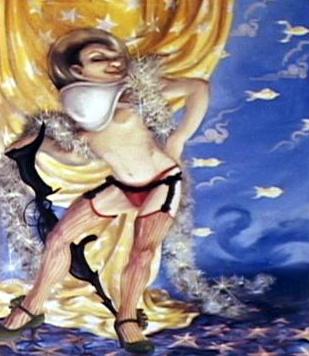
The painting Judy in the Stars (1975) by artist and then professor of art, William Girard, of Royal Oak, Michigan, is based on the then Center for Creative Studies model, Judy Kunesh. At Girard's request, Judy came to a painting class with a variety of props. Girard also brought props, including the "space helmet" of his son, Chris. Judy, dressed in those items, apparently had a good time playing to her audience, art students, on the model's stand, accompanied by a recording of Duke Ellington tunes dating back to the 1920s. Girard had instructed his students that they were to make multiple short sketches. They were then told to develop the sketches into a full painting somewhat later. He, too, made sketches. Judy in the Stars is the result. According to Girard, as recorded by artist Michael Curtis, this painting was initially included in an exhibit at the University of Michigan's Power Center. However, it was subsequently removed as it "was a painting of undetermined sex." Per Girard, the local newspapers had a field day with the story for a period of time. The painting is intended as a spoof of Flash Gordon, one of Girard's favorite childhood cartoon series. Judy's pose is apparently a pastiche of two Hyacinthe Rigaud paintings of Louis XIV (circa 1701). In one, the Sun King stands in elegant stockings of his own, with an extended leg. In the other, his right arm is cocked not unlike Judy's, though at a different angle. The "stars" in the robe of the Sun King (Musée du Louvre) have become star ships in Girard's painting. |
| Judy Detroit Mythic, miraculous, a mother, an oasis, a little queer like the earth, the like the stars; plundered, object to eyes that object, horse mistress; too good to waste, too wasted to be recognized by chumps; distilled, clarified and rectified, pure, more pure; artist, artist’s model, collector’s piece, masterpiece; Judy, earth priestess, witch, oracle, Godmother, presides.
While earth still wobbles, lonely, On an inky circuit Of the outer Milky Way, spermy Droplet on a suction vortex, you can bet on Judy, who never was a virgin, but always staunch and muscled, barbaric as this city, pungent, plain and beautiful. I’d bet on Judy before I’d bet on God.
Glenn Scott Michaels Circa 1981 A self-portrait by Judy Kunesh is featured on the Artifacts page. Read About Judy in the Stars, immediately to above. |
|
Benvenuto Cellini: Sculptor, Goldsmith, Author, Genius
Few are acquainted with the story of Benvenuto Cellini and the loss is theirs. His art and and autobiography make him one of the most memorable figures in European art history, certainly of the Renaissance period.
The Autobiography of Benvenuto Cellini is less an exposition on art than a firsthand retelling of a dashing, historically accurate "romance" (a cross between The Three Musketeers and Vasari's The Lives of Artists) replete with more swordsmanship, marksmanship, stunts and breathtaking escapades than even a Hollywood director could imagine.
Meet the Pope's scheming son and, among many others, the first rascal of art history, Giorgio Vasari, glib in praise, and equally quick with slander, when it suited his purposes. Party with Michael Angelo, sup with the great Duke of Florence and perhaps the greatest art patron of the Renaissance, Cosimo de'Medici. Hobnob with the King of France and parry the vicious ire of his memorable mistress, Madame d'Etampes, whose power over the king made her the second most powerful person in the country.
Immerse yourself in the passion of popes, kings, and dukes, art lovers all, whose own lives are merely appurtenances of a fiery love affair between an artist and his destiny.
Among Cellini's most famous patrons were Pope Clement VII, Pope Paul III, Francis 1 of France, and Cosimo de'Medici of Florence. Unfortunately, most of his works have perished.
His sculptures, most of them executed in the later Florentine period, include the colossal bronze bust of Cosimo I (Bargello); the bronze bust of Altoviti (Gardner Mus., Boston); the Nymph of Fontainebleau (Louvre); the life-size Crucifixion, a white marble Jesus on a black cross (Escorial); and the renowned Perseus with the Head of Medusa (Loggia dei Lanzi, Florence), a beautifully wrought bronze statue surmounting a marble pedestal lavishly adorned with statuettes and carvings. |
Vincent Van Goth. Excerpt from a letter to Emile Bernard. "Painting and f...ing a lot are incompatible; it weakens the brain. Which is a bloody nuisance. "As you know, the symbol of St. Luke, the patron saint of painters, is an ox. So one must be as patient as an ox if one wants to labor in the artistic field. But the bulls are lucky enough not to have to work at that filthy painting." June 1888 Source: The Complete Letters of Vincent Van Goth Volume III Page 494 Publisher: Bullfinch Press (Little, Brown and Company, Inc.) |